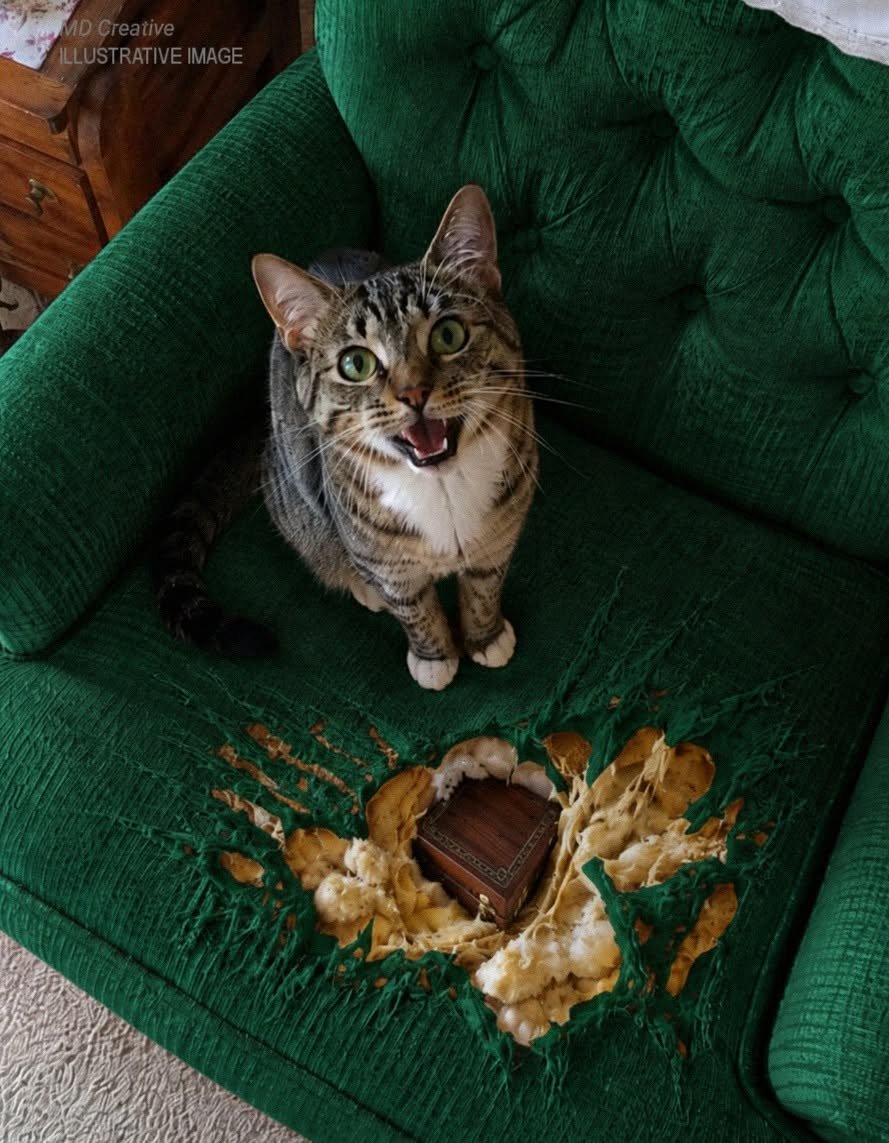
The only things left were the furniture nobody wanted, a few boxes of books, and the old armchair Grandma had kept beside the window for as long as I could remember.
I ran my hand over its faded green fabric.
“That chair is awful,” my aunt said. “Just throw it out.”
I nodded quietly.
After everyone left, the house became painfully silent.
I spent the afternoon sorting through drawers and closets, trying to decide what could be saved. Every few minutes, I found another little piece of Grandma: a handwritten recipe, an old birthday card, a photograph with curled edges.
Then I heard a strange scratching sound.
Grandma’s cat, Oliver, had climbed onto the old armchair.
He sniffed the cushions, circled twice, and suddenly began clawing at the fabric underneath one of the armrests.
“Oliver, stop,” I said, walking toward him.
But the cat wouldn’t.
He scratched harder.
Then his paw disappeared through a small tear.
I froze.
Something was hidden inside the chair.
I carefully pulled the loose fabric back and reached into the opening. My fingers touched something hard.
I pulled it out.
It was a small wooden box covered in dust.
My heart began pounding.
There was no name on it. No keyhole. Just a tiny brass latch.
Inside, I found several envelopes tied together with a faded blue ribbon.
The first envelope had my name written across it.
For my granddaughter. Open only after I’m gone.
I sat down on the floor.
My hands were shaking as I opened it.
The letter began:
“If you’re reading this, then everyone has probably already decided what they think belongs to them.”
I stopped breathing for a moment.
Grandma knew.
She knew exactly what would happen after she died.
The letter continued.
“I didn’t leave my most important possession in a jewelry box or a bank. I left it where nobody would bother looking—in the chair everyone considered worthless.”
Under the letter was a photograph of Grandma as a young woman standing beside a small house.
On the back, she had written an address.
I recognized it immediately.
It was the house where my mother had grown up.
But there was something else inside the box: an old property deed, several bank documents, and a second envelope.
The second envelope contained a letter dated more than thirty years earlier.
That was when I discovered the truth Grandma had kept hidden from our entire family.
The house we were standing in wasn’t the only property she owned.
Years ago, Grandma had quietly purchased the small house where my mother had spent her childhood. She had paid for it in full and kept the deed in her name.
But she hadn’t kept it for herself.
She had been waiting for the right person.
And that person was me.
According to the documents, Grandma had transferred the property into a trust for her granddaughter years before her death.
I stared at the papers in disbelief.
Why had she never told me?
Then I found the final letter.
“You may wonder why I kept this secret. I watched how people behaved whenever money was involved. I wanted to know who loved me for me, and who loved what they thought I could leave behind.”
Tears filled my eyes.
Suddenly, my aunt’s words from earlier echoed in my mind.
We’ve taken everything worth keeping.
But she hadn’t.
None of them had found what Grandma considered most valuable.
At the bottom of the box was one final note.
“Don’t be angry with them. Let them have the things they fought over. China can be replaced. Silver can be sold. Jewelry can be bought again. But kindness, loyalty, and love cannot.”
I sat there for a long time, holding the letter against my chest.
Then Oliver jumped onto my lap and curled up beside me.
I laughed through my tears.
“You knew, didn’t you?”
He purred as if he had been waiting all along for me to discover it.
A week later, my relatives called asking whether I had found anything valuable in the house.
I simply told them no.
I didn’t tell them about the deed.
I didn’t tell them about the trust.
And I certainly didn’t tell them that Grandma had left me something far more meaningful than money.
She had left me proof that she had always seen me.
She had noticed the way I visited her when everyone else was too busy.
She remembered every grocery trip, every birthday, every afternoon I spent listening to stories I’d already heard a dozen times.
And while everyone else had been busy taking things from her house, Grandma had quietly made sure that the person who stayed behind to care for her memories would be the one who received the greatest gift.
I never threw away that armchair.
I had it professionally restored and placed it beside the window in my new home.
And sometimes, when Oliver curls up on it in the afternoon sunlight, I swear I can almost hear Grandma laughing.
Because the chair everyone called junk had been hiding the one thing she never wanted anyone to take from her:
her final secret.