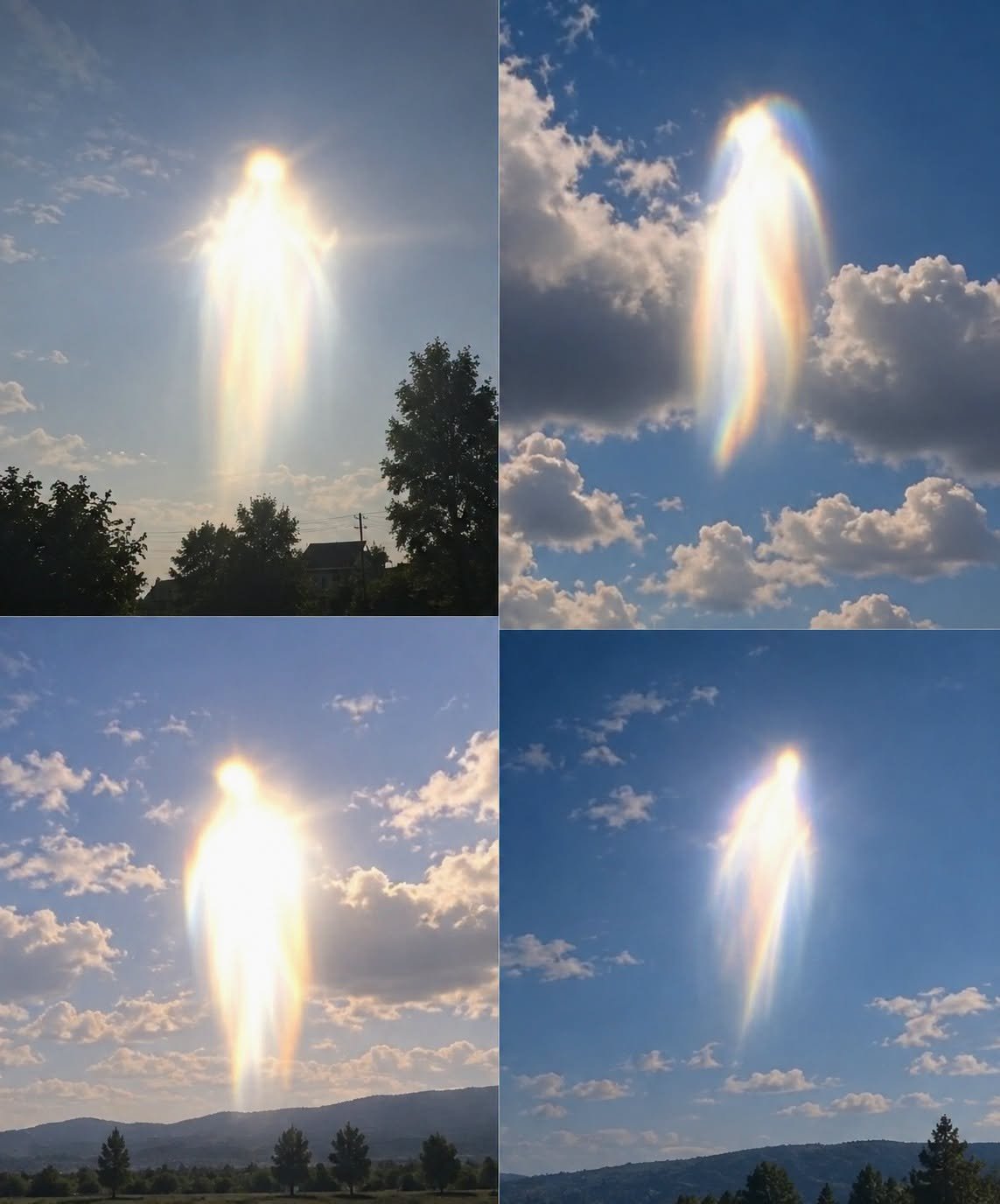
The sky over Ikaria seemed to split open. A glowing shape appeared above the horizon, shifting colors in near silence as people stopped to watch, film, and wonder what they were seeing. Within minutes, speculation spread. Some wondered whether it was a UFO. Others suggested a portal, an unusual atmospheric event, or even some kind of omen.
But the explanation was stranger, colder, and far more grounded than any of those theories.
What appeared to be a mysterious object may have been the result of light interacting with ice crystals, dust, moisture, and layers of air. Atmospheric optics can create halos, pillars, bright patches, arcs, and other shapes that seem remarkably solid when viewed from the right angle.
Sunrise and sunset can make these effects especially dramatic. When sunlight travels through a greater thickness of atmosphere, it encounters changing concentrations of moisture and particles. Tiny ice crystals high in the atmosphere can bend and reflect sunlight, producing luminous structures that appear to hang in the sky.
Over the sea, the scene can become even more deceptive.
The Horizon Can Play Tricks
Ikaria’s position in the Aegean means observers frequently have an enormous, unobstructed view toward the horizon. That makes atmospheric distortions easier to notice.
When layers of air have different temperatures, light traveling through them can bend. This phenomenon, known as atmospheric refraction, can make distant objects appear higher, lower, stretched, compressed, or displaced from their actual position.
Under unusual conditions, distant lights or objects can even appear to float above the horizon.
The human eye then has to interpret an unfamiliar image without enough information to determine exactly what it is.
And that’s where the mystery begins.
Why the Light Appeared to Move
People watching unusual lights often describe them as moving, pulsing, changing shape, or behaving as though they are responding to observers.
That doesn’t necessarily mean the source itself is moving in an extraordinary way.
Atmospheric turbulence can cause light to shimmer and fluctuate in brightness. Tiny changes in temperature and density along the path between the observer and the light source can alter what reaches the eye.
The effect can become surprisingly dramatic when viewed from a distance.
Our brains are also constantly trying to make sense of incomplete visual information. A vague shape can quickly become something recognizable—a craft, a figure, or another object—especially when several people are watching together and discussing what they think they see.
The Internet Makes the Mystery Bigger
Once an unusual event is recorded on a smartphone, the story can travel much faster than the explanation.
A short video showing a glowing object above the horizon can be separated from its original location, time, weather conditions, and camera settings. By the time it reaches social media, viewers may see only a few seconds of footage and have no reliable way to determine what produced the light.
Comments then add competing explanations.
One person sees an aircraft.
Another sees a satellite.
Someone else sees a UFO.
Another person suggests something supernatural.
The more unusual the claim becomes, the more attention it can receive.
That doesn’t mean every unexplained light has an ordinary explanation. It simply means that “unidentified” is not the same thing as “extraterrestrial.”
A Reminder That Nature Can Look Impossible
The most fascinating part of events like this may be that nature doesn’t need to break the laws of physics to look completely alien.
The atmosphere can transform ordinary sunlight into extraordinary shapes. Ice crystals can act like tiny prisms. Temperature differences can bend light across long distances. Clouds, haze, dust, and moisture can alter the appearance of objects that are otherwise perfectly familiar.
Put all those ingredients together over an open sea at the right time of day, and the result can look almost impossible.
For the people watching from Ikaria, the experience may still have been genuinely unsettling. Seeing something unusual with your own eyes can feel very different from reading an explanation afterward.
But mystery doesn’t always require a hidden visitor.
Sometimes it requires nothing more than the right combination of light, atmosphere, distance, and human perception.
The glowing apparition above Ikaria may have seemed like a message from somewhere beyond our world. In reality, it may have been something just as remarkable: a fleeting demonstration of how strange our own world can become when ordinary physics lines up perfectly.
No portal. No cover-up. No proof of visitors from another world. Just a rare moment when the sky became strange enough to make people look twice.