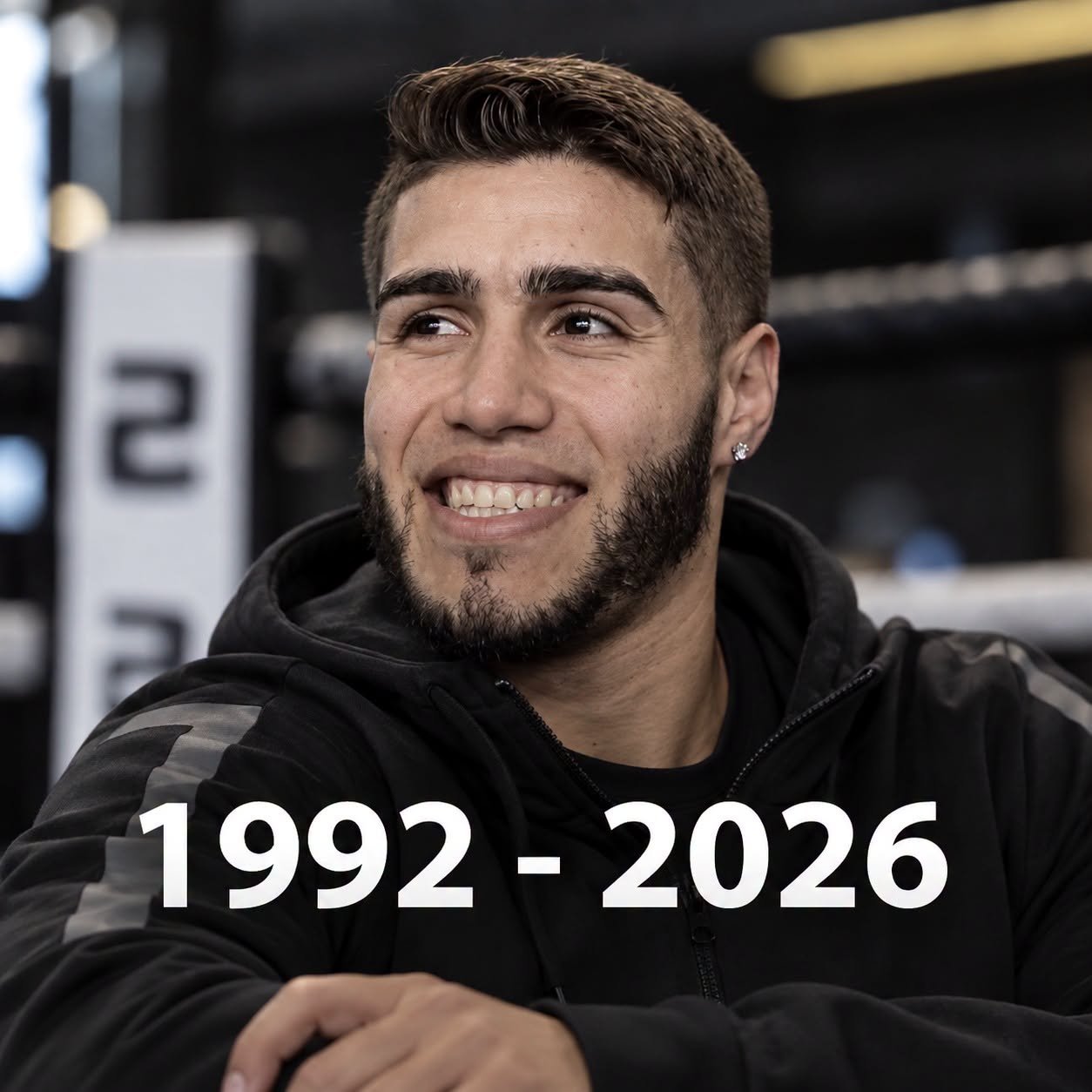
At just 33 years old, Prichard Colón’s long battle has come to an end.
For more than a decade, his name had been tied to one of boxing’s most heartbreaking cautionary stories: a young, undefeated fighter whose promising career ended in a devastating brain injury after a 2015 bout in Virginia.
Colón died in August 2026, 11 years after the fight that permanently changed his life. His father, Richard Colón, announced his death, while the World Boxing Council and World Boxing Organization later paid tribute to the fighter. The cause of death was not publicly detailed in the family’s announcement.
But his story is about much more than how a boxing career ended.
It is about a young man who entered the ring dreaming of becoming a champion—and a family that spent the next 11 years fighting to give him the best life possible.
The Night Everything Changed
On October 17, 2015, Colón entered EagleBank Arena in Fairfax, Virginia, as one of boxing’s promising young prospects.
He was 23 years old and undefeated at 16–0.
Across the ring was Terrel Williams.
What followed became the only defeat on Colón’s professional record—and a fight that would permanently alter both men’s lives.
During the bout, Colón repeatedly absorbed blows to the back of his head. These punches, commonly known as “rabbit punches,” are illegal because of the potentially catastrophic damage they can cause.
Colón complained about the blows during the fight.
A point was deducted from Williams after one illegal shot in the seventh round, but the bout continued. In the ninth round, Colón was knocked down after another blow to the back of the head.
The fight never reached a normal conclusion.
After the ninth round, Colón’s gloves were removed. His corner apparently believed the scheduled 10-round contest had ended. When he was unable to get his gloves back on in time, the referee disqualified him.
Colón walked toward the dressing room.
Then his condition deteriorated rapidly.
He became dizzy, vomited, and collapsed.
He was rushed to the hospital, where doctors discovered a serious brain hemorrhage and performed emergency surgery.
221 Days in a Coma
What happened next was almost impossible for his family to comprehend.
The talented boxer who had entered the arena as an undefeated professional was now fighting simply to survive.
Colón remained in a coma for 221 days.
He eventually survived, but the neurological damage was catastrophic and permanent. His family became his caregivers, supporting him through years of rehabilitation and medical treatment.
He could no longer live the life he had imagined.
The boxing career was gone.
The championship dreams were gone.
The ordinary independence most young people take for granted was gone.
But his family refused to give up on him.
His Mother and Father Became His Corner Team
In boxing, a fighter’s corner is supposed to be the place where someone tells him when to push forward and when to protect himself.
After Colón’s injury, that idea took on an entirely different meaning.
His parents, Nieves and Richard, devoted themselves to their son.
The WBC later described their dedication as extraordinary and honored Colón as an Honorary World Champion, recognizing not only the fighter he had been but the resilience he displayed after the injury.
Rehabilitation became part of everyday life.
Beginning in 2018, Colón received speech, occupational, and physical therapy at Brooks Rehabilitation. His progress was slow, but his determination and his family’s commitment remained constant.
His story eventually reached far beyond Puerto Rico and the boxing community.
People who had never seen him fight came to know him for something other than his record.
They knew him for his courage.
The “Prichard Colón Rule”
Colón’s injury also forced boxing authorities to confront the danger of rabbit punches.
In 2020, the WBC issued explicit instructions to referees to apply its “Prichard Colón Rule” more rigorously.
The guidance called for referees to warn fighters about rabbit punches before the bout, stop the action when illegal blows occurred, deduct points when necessary, and use disqualification when the behavior continued. The WBC emphasized that action should be taken immediately rather than waiting until a medical crisis developed.
The organization has repeatedly said that Colón’s tragedy helped inspire stronger safety measures and a zero-tolerance approach toward blows to the back of the head.
That doesn’t undo what happened to him.
It doesn’t give him back the career he lost.
And it certainly doesn’t erase the suffering his family endured.
But it means his name became attached to a lesson the sport could not easily ignore.
He Was More Than the Fight
It can be tempting to remember Colón only through the footage of that terrible night.
But before October 17, 2015, he was a young man with an extraordinary future ahead of him.
He had won a gold medal at the 2010 Pan American Youth Championship and entered the professional ranks with enormous promise. He won his first 16 professional fights and quickly developed a reputation as an exciting prospect.
His life was supposed to be about the next fight.
The next victory.
The next championship opportunity.
Instead, his family was forced to learn how to measure progress in much smaller victories.
A movement.
A response.
A moment of communication.
A day without a medical crisis.
Those victories may never have appeared on a boxing record, but they mattered enormously.
His Final Years
Colón spent the years after his injury largely away from public life, surrounded by his family and caregivers.
His father continued to share updates and express gratitude for the people who prayed for and supported Prichard.
In August 2026, Richard announced that his son had died.
He thanked those who had shown love and support throughout the long ordeal and asked people to continue remembering the family in their prayers.
The boxing world responded with tributes.
The WBC called Colón a “Champion of the Heart” and emphasized the resilience and dignity he showed throughout his years of suffering.
A Legacy Written Outside the Ring
Prichard Colón never became the world champion many believed he could have become.
His professional record stopped at 16–1.
But his legacy ultimately became something different.
His story forced people to confront a question boxing has wrestled with throughout its history:
How much punishment is too much?
A fighter’s courage cannot be the only measure of whether a fight should continue.
A referee’s job isn’t simply to enforce rules after something goes wrong. It is also to recognize danger before an irreversible injury occurs.
And an illegal punch isn’t merely a technical violation when the human brain is at risk.
Colón’s tragedy became part of the reason boxing authorities pushed harder for immediate intervention when fighters are struck behind the head.
The Fight He Never Chose
For 11 years, Prichard Colón fought a battle he never expected to fight.
It wasn’t fought under bright arena lights.
There were no judges.
No championship belt waited at the end.
His opponents were brain injury, disability, physical limitations, and the enormous uncertainty that followed the worst night of his young life.
Yet he kept going—with his family beside him.
Now that fight is over.
Prichard Colón will be remembered not only as the undefeated prospect who lost his career in one devastating night, but as the young Puerto Rican fighter whose suffering changed the conversation around one of boxing’s most dangerous fouls.
His story cannot change what happened in that ring.
But it can remind the sport why the rules exist in the first place.
A fighter’s life must always matter more than the fight.