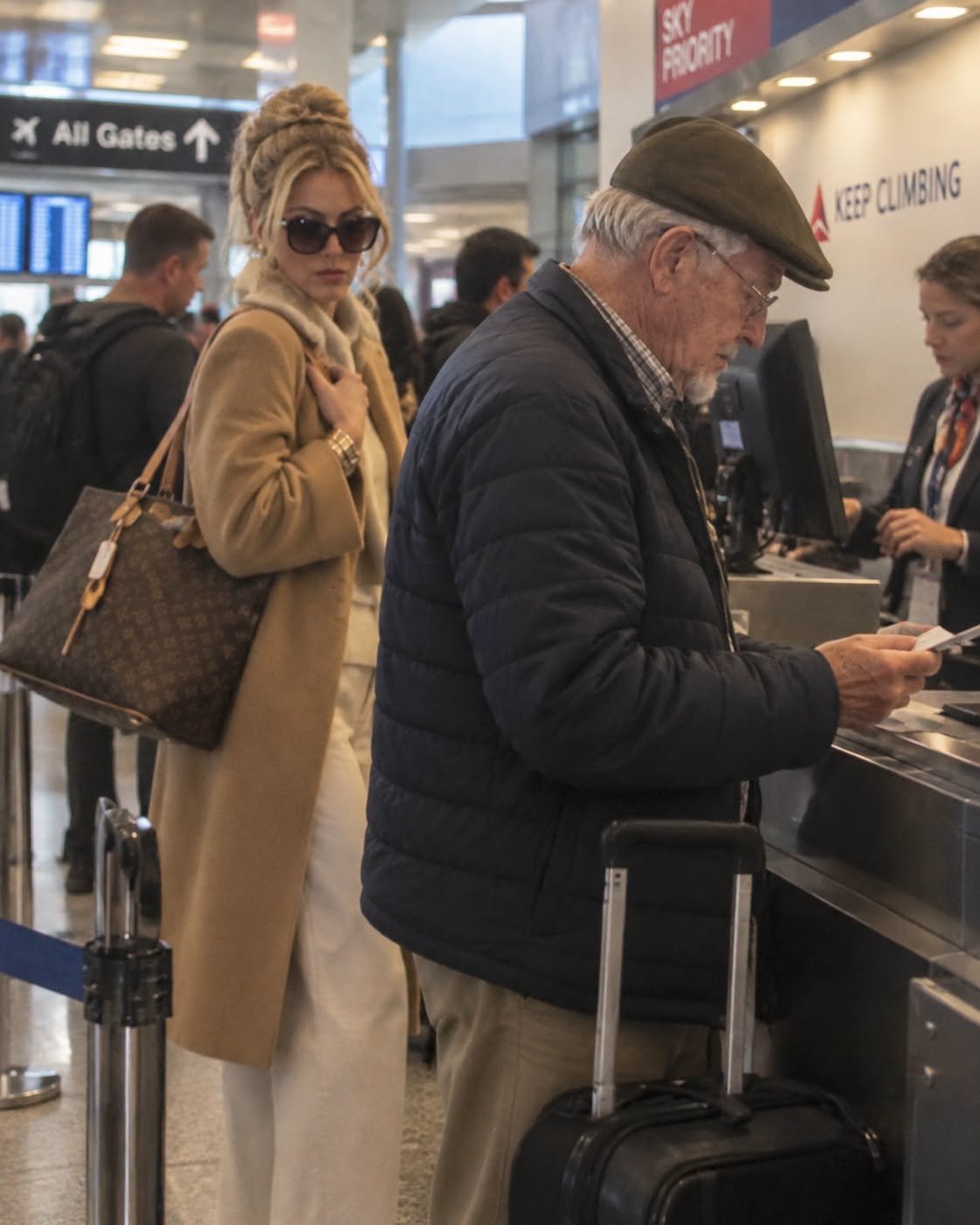
He never wanted applause. What he wanted was to stand in the same line as everyone else, needing no title or legend to justify a little patience. That morning, the airport tried to honor a retired captain who once brought a crippled aircraft home. He kept insisting it was the crew, the procedures, the people on the ground. But the way strangers straightened when they recognized him said something different: his quiet integrity had rippled outward for decades.
My father had spent the last several years telling everyone he was “just maintenance.” He woke before sunrise, repaired little things around the house, complained about loose hinges, and carried the same battered toolbox everywhere. If anyone asked about his past, he changed the subject.
So when we arrived at the airport that morning, I expected nothing unusual.
He moved slowly through the terminal, leaning lightly on his cane. A man behind us grew impatient and muttered, “Come on, grandpa. Some of us actually have places to be.”
I turned around immediately, but Dad gently touched my arm.
“Leave it,” he whispered. “He doesn’t know me.”
A few seconds later, everything changed.
Near the security checkpoint, two uniformed pilots suddenly stopped. One stared at my father for several seconds before removing his cap.
The other did the same.
“Captain?” he said quietly.
Dad looked embarrassed.
“Please don’t.”
But the pilots stepped forward and shook his hand.
Then the security supervisor saw him.
His expression changed completely.
“Sir,” he said, almost whispering. “Is that really you?”
Dad sighed.
“I suppose it is.”
The supervisor immediately called someone. Within minutes, airport staff began gathering nearby—not for a celebrity, but for a man they remembered from stories told by older crews.
Decades earlier, Dad had been captain of a passenger aircraft that suffered a catastrophic mechanical failure shortly after takeoff. The plane lost critical systems, and the crew faced a decision that could have ended very differently.
Dad didn’t panic.
He relied on his training, trusted his crew, communicated with the ground team, and brought the damaged aircraft back safely.
Every passenger survived.
For years afterward, people called him a hero.
He hated the word.
Whenever someone mentioned the incident, Dad always said the same thing:
“I didn’t save that aircraft alone. Everyone did their job.”
That explained the pilots’ reaction.
They had heard his name during training. Some had studied the incident. Others had flown with people who had been on that crew.
And now the elderly man they recognized was standing in an ordinary airport line, apologizing for moving too slowly.
The stranger who had mocked him earlier had gone completely silent.
He approached my father with an uncomfortable expression.
“Sir,” he said, “I’m sorry. I didn’t know.”
Dad smiled.
“You didn’t need to know.”
The man looked down.
“I should’ve been patient anyway.”
Dad nodded.
“That would’ve been enough.”
Then, instead of accepting the attention around him, Dad did something that surprised everyone.
He pointed toward an airport employee struggling with a heavy cart.
“Go help him,” he said.
The man immediately did.
Dad chuckled softly.
“See? Much more useful than shaking my hand.”
As we finally reached the gate, I asked him why he’d hidden his past for so long.
He looked through the window at the aircraft waiting on the runway.
“Because,” he said, “the best things you do in life aren’t supposed to become your identity.”
I asked what he meant.
He smiled.
“You don’t need people to remember your name. You just need to leave something behind that makes their lives a little safer, kinder, or better.”
Then he picked up his old maintenance bag and slowly walked toward the gate.
For the first time, I understood.
My father hadn’t spent his life trying to be remembered.
He had spent it making sure other people got home safely.
And perhaps that was the greatest title he ever earned.