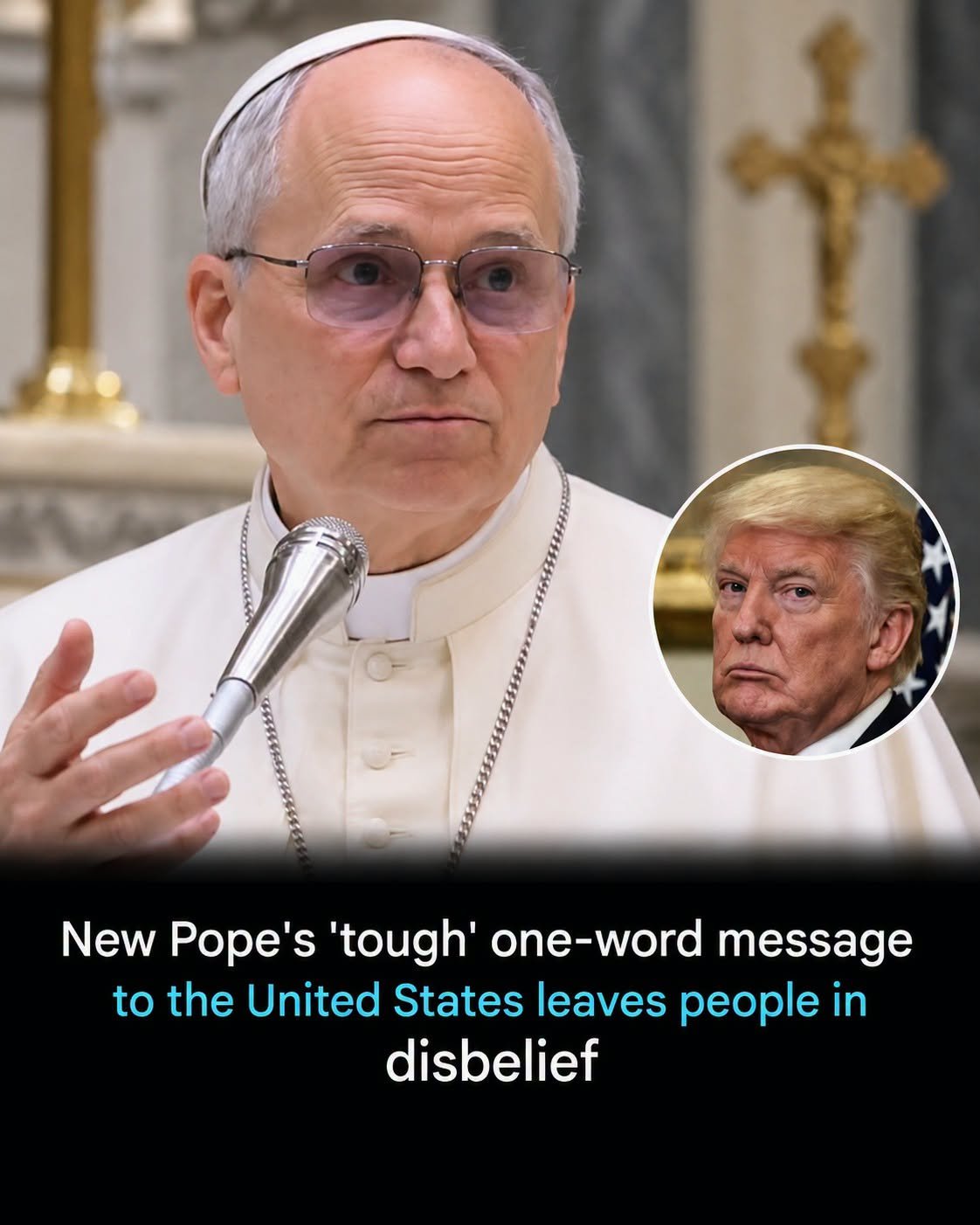
His answer was one word.
And it was enough to make people stop and think.
In May 2025, shortly after his election as the first American pope, Leo XIV was approached by NewsNation correspondent Robert Sherman as he left an audience with journalists at the Vatican. Sherman asked whether the new pope had a message for the United States.
Leo smiled and answered:
“Many.”
He then added, “God bless you all.” The Daily Beast
It was a tiny exchange. But the word quickly became a talking point because it refused to provide the kind of instant political answer American media and politics often demand.
There was no endorsement.
No criticism.
No campaign-style slogan.
Just: Many.
The Question Was Bigger Than the Answer
The power of the moment came partly from the fact that Leo had been elected only days earlier.
As the first pope born in the United States, he immediately faced enormous expectations. Americans wanted to know what kind of pope he would be. Conservatives wondered whether he would challenge progressive Catholic positions. Liberals wondered whether he would continue Pope Francis’ emphasis on migrants, poverty, and social justice.
And politicians had their own questions.
But Leo’s response suggested that he wasn’t interested in reducing the papacy to an American political category.
The word “Many” could mean many messages, many concerns, many prayers—or simply many things that remained to be said.
The vagueness was precisely what made it interesting.
He Wasn’t Actually Giving America a Political Verdict
It’s important not to read more into the exchange than the evidence supports.
Contemporary coverage described Leo’s response largely as a humorous and diplomatic deflection rather than a coded political declaration. America magazine later characterized it as essentially a “no comment” delivered with reserve and good humor. America Magazine
That distinction matters.
The pope wasn’t literally listing America’s problems when he said “Many.”
The more provocative interpretation—that the single word represented a sweeping indictment of American society—is an interpretation, not something Leo explicitly stated at that moment.
But his broader statements since then do provide clues about the issues he considers important.
What Leo Has Actually Talked About
Since becoming pope, Leo has repeatedly spoken about poverty, migration, peace, human dignity, inequality, and the need to resist division.
In his 2025 apostolic exhortation Dilexi te, he wrote extensively about poverty and warned against allowing people experiencing poverty to become invisible. Vatican
During his international travels, he has also emphasized peace and rejected the idea that war should be treated as an acceptable solution.
Speaking during a 2026 press conference, Leo said that as a pastor he could not support war and urged people to seek solutions based on a “culture of peace” rather than hatred and division. Vatican News
His comments on migration have similarly emphasized that the issue is complicated and global rather than something that can be reduced to a single political slogan. Vatican News
So while “Many” wasn’t a detailed political statement, the pope’s subsequent record has made clear that he intends to speak about difficult social questions.
Why His American Identity Matters
Leo’s American background makes his position particularly unusual.
Previous popes could criticize American policies from the outside. Leo was born in Chicago and spent significant parts of his life working in Peru before becoming pope.
That gives him a different relationship with the United States.
He understands American culture from personal experience, but he now speaks as the spiritual leader of a worldwide Catholic Church.
That creates an unusual balancing act.
He can speak directly to Americans without allowing the papacy to become an extension of American politics.
And that distinction has become increasingly important.
The Tension With Washington
Leo’s relationship with President Donald Trump has subsequently become much more complicated.
In 2026, Trump publicly criticized the pope over several issues, including foreign policy and the pope’s approach to political questions. Leo responded that he had “no fear of the Trump administration.” The Washington Post
The dispute illustrated why Leo’s political position is so difficult to categorize.
He has criticized policies and attitudes associated with the Trump administration, particularly around war and immigration, but he has also resisted presenting himself as a partisan political opponent.
Leo has repeatedly described his primary role as pastoral.
In other words, he sees himself first as a pope responsible for the Church—not as an American political actor.
“Many” Became More Interesting With Time
That’s what makes the original exchange worth revisiting.
In isolation, “Many” was simply a clever answer.
With the benefit of hindsight, it looks almost symbolic.
There really have been many messages.
Messages about peace.
Messages about migrants.
Messages about poverty.
Messages about human dignity.
Messages about political polarization.
Messages about the responsibilities of powerful governments.
And messages directed toward Catholics themselves.
When Leo addressed the United States for its 250th anniversary in July 2026, he emphasized unity, freedom, human dignity, equality, peace, and the country’s unfinished effort to live up to its founding ideals. America Magazine
That was considerably more detailed than his four-letter answer in 2025.
But the underlying approach was similar: challenge people to think beyond immediate political loyalties.
A Pope Who Doesn’t Want to Be Anyone’s Political Property
Perhaps that’s the real significance of the moment.
A pope can become politically useful to almost everyone.
One group can quote him on immigration.
Another can quote him on abortion.
Another can quote him on poverty.
Another can highlight his criticism of war.
But Leo’s approach makes it harder to place him neatly inside one political camp.
He has spoken about issues that resonate with different sides of the political spectrum while resisting the idea that the Church should become an arm of either party.
That can frustrate people who want a simple answer.
But it may also be exactly the point.
The Four-Letter Answer
When the reporter asked for a message to America, Leo could have offered a carefully prepared sentence.
Instead, he smiled.
“Many.”
Then he blessed the people asking the question.
There was no dramatic political declaration hidden inside those four letters.
But there was something revealing about the way Leo approached the moment: he didn’t allow a complicated country, a complicated Church, and a complicated political landscape to be compressed into one convenient slogan.
And perhaps that is why the answer has endured.
Because America doesn’t have one problem.
It doesn’t have one political identity.
And it certainly doesn’t have one simple solution.
Many problems require many conversations—and a pope who intends to keep speaking may have many more messages still to deliver.