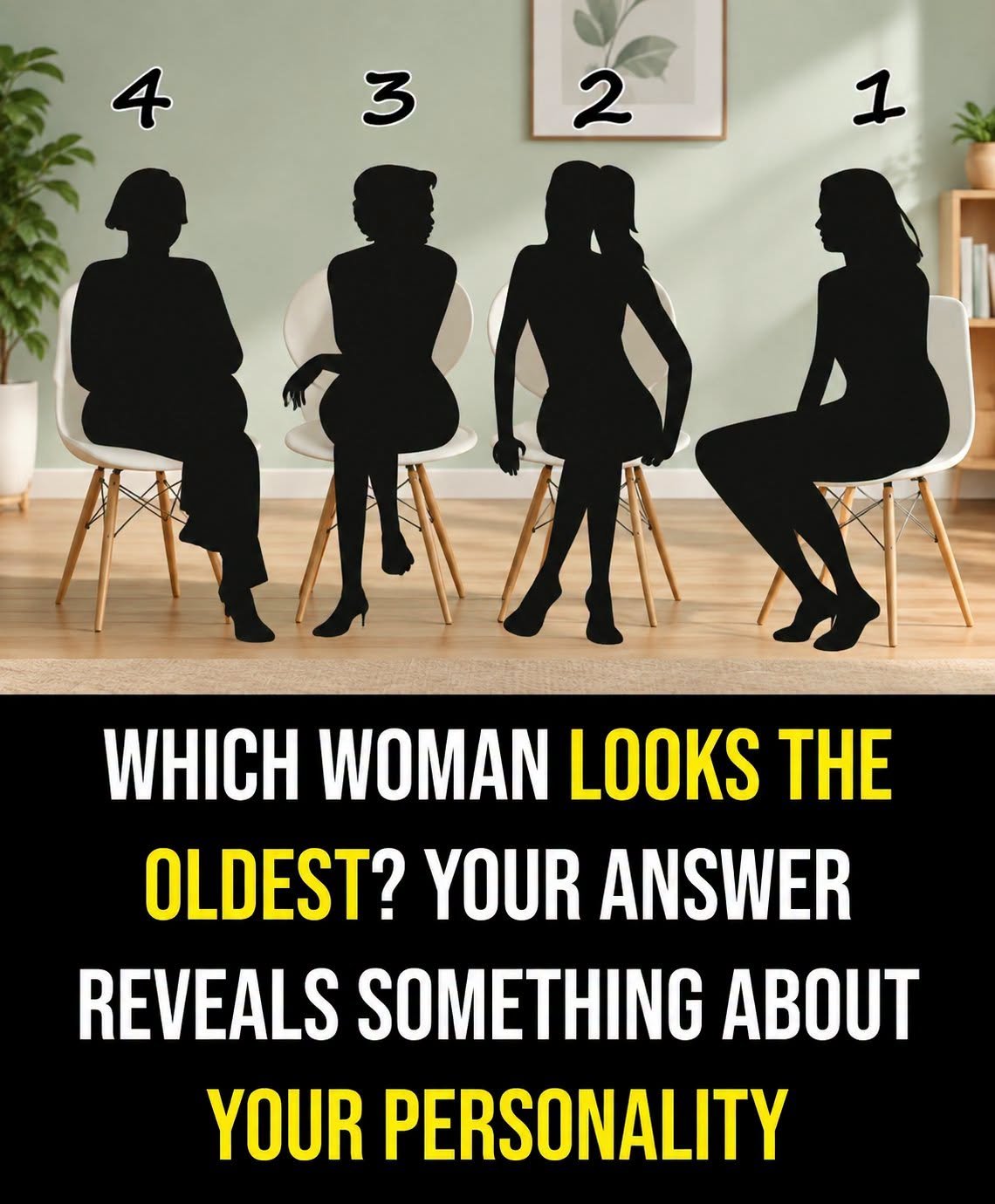
You thought it was just a picture.
Four women. One simple question: Which woman looks oldest?
It sounds like a harmless visual puzzle, but your choice can become a surprisingly interesting window into the way you interpret people. The face you notice first, the expression that catches your attention, and the qualities you instinctively associate with age may reveal something about your own personality.
Of course, this isn’t a scientifically validated personality test. There is no reliable way to determine someone’s character simply by asking which person appears oldest. Your answer can be influenced by lighting, facial expression, hairstyle, posture, cultural expectations, and countless other visual details.
Think of it as a fun self-reflection exercise, not a psychological diagnosis.
If You Chose Woman 1: You Notice Strength First
If the first woman appeared oldest to you, you may naturally pay attention to confidence and composure.
You could be someone who respects people who remain calm when circumstances become difficult. Rather than focusing on appearances alone, you may look for signs of experience in someone’s posture, expression, and behavior.
People with this tendency are often drawn to stability.
You may be the person friends call when they need practical advice because you tend to keep a clear head when everyone else is overwhelmed.
But there may be another side to it.
You might sometimes assume that people who appear confident have everything under control, even when they may be struggling privately.
Your challenge may be remembering that strength doesn’t always look confident.
If You Chose Woman 2: You Look for Experience
Choosing the second woman may suggest that you are particularly attentive to subtle details.
Rather than making an immediate judgment based on one obvious feature, you may instinctively compare facial expressions, eyes, posture, and overall appearance.
You could be someone who likes understanding the story behind a person.
You don’t necessarily trust first impressions.
Instead, you prefer to watch, listen, and gather information before deciding what someone is really like.
That quality can make you a thoughtful friend and a careful decision-maker.
However, you may occasionally overanalyze situations that don’t require quite so much thought.
Sometimes the simplest explanation really is enough.
If You Chose Woman 3: Emotion May Catch Your Attention
If Woman 3 looked oldest to you, you may be particularly sensitive to emotional signals.
Perhaps there was something about her expression that suggested tiredness, sadness, seriousness, or experience.
Your brain may have interpreted that emotional quality as a sign of age.
That can indicate that you naturally look beyond surface-level appearances.
You may notice when someone’s mood changes, even when they insist everything is fine. In relationships, you might be especially aware of tone of voice, facial expressions, and small changes in behavior.
Your sensitivity can be a strength.
But it can also mean that you sometimes absorb other people’s emotions more than you realize.
Learning to distinguish your feelings from someone else’s can be important for people who are highly empathetic.
If You Chose Woman 4: You May Trust Logic
If the fourth woman immediately seemed oldest, you might be approaching the puzzle differently.
Instead of being drawn toward emotion or expression, perhaps you focused on specific visual evidence that made her appear older to you.
This may reflect a preference for logic and observable details.
You may like decisions that have clear reasons behind them. In everyday life, you might be uncomfortable making important choices based purely on instinct.
People with this tendency often appreciate structure, consistency, and evidence.
The downside is that you may occasionally dismiss your intuition too quickly.
Not every important decision can be reduced to facts and numbers.
Why Did You See Age Differently?
Here’s the most interesting part of the test.
There may not be one universally obvious answer.
Two people can look at exactly the same image and immediately choose different women. One person notices wrinkles. Another notices posture. Someone else focuses on the eyes or expression.
Their brains aren’t necessarily seeing different photographs.
They’re prioritizing different information.
That’s why visual personality quizzes can feel strangely accurate. They encourage us to think about what our attention naturally gravitates toward.
If you immediately noticed someone’s eyes, perhaps you tend to read emotion.
If you noticed posture, perhaps you associate confidence with experience.
If you focused on facial structure, perhaps you rely more heavily on concrete visual details.
None of these observations proves anything about your personality—but they can give you something interesting to think about.
Your First Impression Isn’t Always the Truth
There’s another lesson hidden inside this simple test.
Human beings are remarkably quick to make judgments.
Within moments of seeing another person, we begin forming impressions about their age, mood, confidence, trustworthiness, and even personality.
But those impressions can be wrong.
Someone who looks serious may simply be tired.
Someone who looks confident may actually be nervous.
Someone who appears distant may simply be shy.
And someone who looks older may simply have an expression or hairstyle that your brain associates with age.
The mind doesn’t wait for all the evidence.
It makes a prediction and then tries to build a story around it.
So, What Did Your Choice Reveal?
Maybe your choice revealed something meaningful about the way you pay attention.
Maybe it revealed absolutely nothing beyond which face looked oldest to you in that particular image.
And that’s perfectly fine.
The real value of a personality picture like this isn’t discovering a secret psychological diagnosis hidden inside your answer.
It’s the question that comes afterward:
Why did I choose her?
What did you notice first?
What assumption did you make?
And would you make the same judgment if you were given more information about each person?
Sometimes, a simple picture can remind us that the first story our brain creates isn’t necessarily the whole story.
Your choice may not reveal your entire character—but the reason behind your choice might reveal something interesting about the way you see people, emotions, and the world around you.